This is from a Chinese professor. This is amazing. Please keep this handy.. Excellent tips. Do take a minute to read this. You never know.....someone's life may depend on you one day!! Keep a syringe or needle in your home to do this... It's amazing and an unconventional way of recovering from stroke, read it through.
'My father was paralyzed and later died from the result of a stroke. I wish I knew about this first aid before today. When stroke strikes, the capillaries in the brain will gradually burst.
When witness a stroke occurring, stay calm. No matter where the victim is, do not move him/her. Because, if moved, the capillaries will burst. Gently help the victim to sit up. Prevent him from falling over again, and then the bloodletting can begin. If you have in your home an injection syringe that would be the best, otherwise, a sewing needle or a straight pin will do.
1. Place the needle/pin over fire to sterilize it, and then use it to prick the tip of all 10 fingers.
2. There are no specific acupuncture points, just prick about a mm from the fingernail.
3. Prick till blood comes out.
4. If blood does not start to drip, then squeeze with your fingers.
5. When all 10 digits is bleeding, wait a few minutes then the victim will regain consciousness.
6. If the victim's mouth is crooked, then pull on his ears until they are red.
7. Then prick each ear lobe twice until two drops of blood comes from each ear lobe. After a few minutes the victim should regain consciousness.
Wait till the victim regain his normal state without any abnormal symptoms then take him to the hospital, otherwise, if he was taken in the ambulance in a hurry to the hospital, the bumpy trip will cause all the capillaries in his brain to burst. If he could save his life, barely managing to walk, then it is by the grace of his ancestors.
' I learned about letting blood to save life from Chinese traditional doctor Ha Bu-Ting who lives in Sun-Juke. Furthermore, I had practical experience with it. Therefore I can say this method is 100% effective.In 1979, I was teaching inFung-Gaap College in Tai-Chung. One afternoon I was teaching class when another teacher came running to my class room and said in panting, 'Ms. Liu, come quick, our supervisor has had a stroke!'
I immediately went to the 3rd floor. When I saw our supervisor, Mr.Chen Fu-Tien, his color was off, his speech was slurred, his mouth was crooked-all the symptoms of a stroke. I immediately asked one of the practicum students to go to the pharmacy outside the school to buy a syringe, which I used to prick Mr. Chen's 10 fingers tips. When all 10 fingers were bleeding (each with a pea-sized drop of blood), after a few minutes, Mr. Chen's face regained its color and his eyes' spirit returned, too. But his mouth was still crooked. So I pulled on his ears to fill them with blood. When his ears became red, I pricked his right earlobe twice to let out 2 drops of blood. When both earlobes had two drops of blood each, a miracle happened. Within 3-5 minutes the shape of his mouth returned to normal and his speech became clear. We let him rest for a while and have a cup of hot tea, then we helped him go down the stairs, drove him to Wei-Wah Hospital . He rested one night and was released the next day to return to school to teach.
Everything worked normally. There were no ill after-effects. On the other hand, the usual stroke victim usually suffers irreparable bursting of the brain capillaries on the way to the hospital. As a result, these victims never recover.- ' (Irene Liu)
Therefore stroke is the second cause of death. The lucky ones will stay alive but can remain paralyzed for life. It is such a horrible thing to happen in one's life. If we can all remember this bloodletting method and start the life-saving process immediately, in a short time, the victim will be revived and regain 100% normality.
This note is as exactly as I read it.
Wednesday, November 30, 2011

Are you a MBA or a BE graduate?
This particular joke won an award for the best joke in a competition organized in Britain and this joke was sent by an Indian......
A MBA and a BE student go on a camping trip, set up their tent ,and fell asleep. Some hours later, the BE wakes his MBA friend and says "Look up at the sky and tell me what you see.
"The MBA replies, "I see millions of stars."
The BE asks, "What does that tell you?" The MBA ponders for a minute. "Astronomically speaking, it tells me that there are millions of galaxies and potentially billions of planets. Astrologically, it tells me that Saturn is in Leo. Time wise, it appears to be approximately a quarter past three. Theologically, it's evident the Lord is all-powerful and we are small and insignificant. Meteorologically, it seems we will have a beautiful day tomorrow. What does it tell you?"
The BE is silent for a moment, then speaks.
"Practically...Someone has stolen our tent".
"ENGINEERING = 100% COMMON SENSE"
Time understands Love?
Once upon a time, there was an island where all the feelings lived:
Happiness, Sadness, Knowledge, and all of the others, including Love.
One day it was announced to the feelings that the island would sink, so all constructed boats and left. Except for Love.
Love was the only one who stayed. Love wanted to hold out until the last possible moment.
When the island had almost sunk, Love decided to ask for help.
Richness was passing by Love in a grand boat. Love said, "Richness, can you take me with you?"
Richness answered, "No, I can't. There is a lot of gold and silver in my boat. There is no place here for you."
Love decided to ask Vanity who was also passing by in a beautiful vessel."Vanity, please help me!""I can't help you, Love. You are all wet and might damage my boat," Vanity answered.
Sadness was close by so Love asked, "Sadness, let me go with you."
"Oh . . . Love, I am so sad that I need to be by myself!"
Happiness passed by Love, too, but she was so happy that she did not even hear when Love called her.
Suddenly, there was a voice, "Come, Love, I will take you."It was an elder. So blessed and overjoyed, Love even forgot to ask the elder where they were going. When they arrived at dry land,The elder went her own way. Realizing how much Love owed the elder, Love asked Knowledge, another elder, "Who Helped me?""It was Time," Knowledge answered."Time?" asked Love. "But why did Time help me?"Knowledge smiled with deep wisdom and answered, "Because only Time is capable of understanding how valuable Love is."
Happiness, Sadness, Knowledge, and all of the others, including Love.
One day it was announced to the feelings that the island would sink, so all constructed boats and left. Except for Love.
Love was the only one who stayed. Love wanted to hold out until the last possible moment.
When the island had almost sunk, Love decided to ask for help.
Richness was passing by Love in a grand boat. Love said, "Richness, can you take me with you?"
Richness answered, "No, I can't. There is a lot of gold and silver in my boat. There is no place here for you."
Love decided to ask Vanity who was also passing by in a beautiful vessel."Vanity, please help me!""I can't help you, Love. You are all wet and might damage my boat," Vanity answered.
Sadness was close by so Love asked, "Sadness, let me go with you."
"Oh . . . Love, I am so sad that I need to be by myself!"
Happiness passed by Love, too, but she was so happy that she did not even hear when Love called her.
Suddenly, there was a voice, "Come, Love, I will take you."It was an elder. So blessed and overjoyed, Love even forgot to ask the elder where they were going. When they arrived at dry land,The elder went her own way. Realizing how much Love owed the elder, Love asked Knowledge, another elder, "Who Helped me?""It was Time," Knowledge answered."Time?" asked Love. "But why did Time help me?"Knowledge smiled with deep wisdom and answered, "Because only Time is capable of understanding how valuable Love is."
Monday, November 28, 2011
Lateral Thinking
Many years ago in a small Indian village,
A farmer had the misfortune of owing a large sum of money to a village moneylender. The Moneylender, who was old and ugly, fancied the farmer's beautiful Daughter. So he proposed a bargain.
He said he would forgo the farmer's debt if he could marry his Daughter. Both the farmer and his daughter were horrified by the Proposal.So the cunning money-lender suggested that they let Providence decide the matter. He told them that he would put a black Pebble and a white pebble into an empty money bag. Then the girl would have to pick one pebble from the bag.
1) If she picked the black pebble, she would become his wife and her father's debt would be forgiven.
2) If she picked the white pebble she need not marry him and her father's debt would still be forgiven.
3) But if she refused to pick a pebble, her father would be thrown into Jail. They were standing on a pebble strewn path in the farmer's field. As They talked, the moneylender bent over to pick up two pebbles. As he Picked them up, the sharp-eyed girl noticed that he had picked up two Black pebbles and put them into the bag.
He then asked the girl to pick A pebble from the bag.
Now, imagine that you were standing in the field. What would you have Done if you were the girl? If you had to advise her, what would you Have told her?
Careful analysis would produce three possibilities:
1 The girl should refuse to take a pebble.
2. The girl should show that there were two black pebbles in the bag And expose the money-lender as a cheat.
3. The girl should pick a black pebble and sacrifice herself in order To save her father from his debt and imprisonment. Take a moment to ponder over the story. The above story is used with The hope that it will make us appreciate the difference between lateral And logical thinking.
The girl's dilemma cannot be solved with Traditional logical thinking. Think of the consequences if she chooses The above logical answers. What would you recommend to the Girl to do?
Well, here is what she did ....
The girl put her hand into the moneybag and drew out a pebble. Without Looking at it, she fumbled and let it fall onto the pebble-strewn path Where it immediately became lost among all the other pebbles.
"Oh, how clumsy of me," she said. "But never mind, if you look into the Bag for the one that is left, you will be able to tell which pebble I Picked."
Since the remaining pebble is black, it must be assumed that she had Picked the white one. And since the money-lender dared not admit his Dishonesty, the girl changed what seemed an impossible situation into An extremely advantageous one.
MORAL OF THE STORY:
Most complex problems do have a solution. It is only that we don't Attempt to think.
Reading this, I felt that this incident was similar to what i saw in a Korean Drama. There is a king who kills all the traders who try to trade in Tea to their country. One girl is also among those traders as she was trying to help them sneak it out. The King usually holds two coins painted red and will ask the person to be punished to chose one coin. He will say there is one green and one red. If you choose red, you will be killed and if you choose green, you will be freed. Similarly this cruel king did to the girl holding two red coins. This the girl noticed and as she wanted to save herself along with 5 other traders, she gobbled one of the coins and said the King to check the other coin. Seeing her Intelligence, the King will send off all the traders free. I appreciated the idea of the director immediately and now I know its "Lateral Thinking"
A farmer had the misfortune of owing a large sum of money to a village moneylender. The Moneylender, who was old and ugly, fancied the farmer's beautiful Daughter. So he proposed a bargain.
He said he would forgo the farmer's debt if he could marry his Daughter. Both the farmer and his daughter were horrified by the Proposal.So the cunning money-lender suggested that they let Providence decide the matter. He told them that he would put a black Pebble and a white pebble into an empty money bag. Then the girl would have to pick one pebble from the bag.
1) If she picked the black pebble, she would become his wife and her father's debt would be forgiven.
2) If she picked the white pebble she need not marry him and her father's debt would still be forgiven.
3) But if she refused to pick a pebble, her father would be thrown into Jail. They were standing on a pebble strewn path in the farmer's field. As They talked, the moneylender bent over to pick up two pebbles. As he Picked them up, the sharp-eyed girl noticed that he had picked up two Black pebbles and put them into the bag.
He then asked the girl to pick A pebble from the bag.
Now, imagine that you were standing in the field. What would you have Done if you were the girl? If you had to advise her, what would you Have told her?
Careful analysis would produce three possibilities:
1 The girl should refuse to take a pebble.
2. The girl should show that there were two black pebbles in the bag And expose the money-lender as a cheat.
3. The girl should pick a black pebble and sacrifice herself in order To save her father from his debt and imprisonment. Take a moment to ponder over the story. The above story is used with The hope that it will make us appreciate the difference between lateral And logical thinking.
The girl's dilemma cannot be solved with Traditional logical thinking. Think of the consequences if she chooses The above logical answers. What would you recommend to the Girl to do?
Well, here is what she did ....
The girl put her hand into the moneybag and drew out a pebble. Without Looking at it, she fumbled and let it fall onto the pebble-strewn path Where it immediately became lost among all the other pebbles.
"Oh, how clumsy of me," she said. "But never mind, if you look into the Bag for the one that is left, you will be able to tell which pebble I Picked."
Since the remaining pebble is black, it must be assumed that she had Picked the white one. And since the money-lender dared not admit his Dishonesty, the girl changed what seemed an impossible situation into An extremely advantageous one.
MORAL OF THE STORY:
Most complex problems do have a solution. It is only that we don't Attempt to think.
Reading this, I felt that this incident was similar to what i saw in a Korean Drama. There is a king who kills all the traders who try to trade in Tea to their country. One girl is also among those traders as she was trying to help them sneak it out. The King usually holds two coins painted red and will ask the person to be punished to chose one coin. He will say there is one green and one red. If you choose red, you will be killed and if you choose green, you will be freed. Similarly this cruel king did to the girl holding two red coins. This the girl noticed and as she wanted to save herself along with 5 other traders, she gobbled one of the coins and said the King to check the other coin. Seeing her Intelligence, the King will send off all the traders free. I appreciated the idea of the director immediately and now I know its "Lateral Thinking"
My Son's Best Uncle's Birthday!
Its not an easy thing to get into kids mind these days with so many distractions around. They tend to forget people quickly if they dont see them continously for 3 to 4 months. But this brother of mine is really a wonderful person. He got straight thru their hearts by his love,care and share nature. Even though we are not from same mothers, he always had been one of my own. With his small gestures of running over to see them whenever we visit India, sitting along with them, talking to them, spending all his time with them...he got a big place in their hearts. My son has made him a greeting card for his birthday and says that he will mail it over to him even it gets to him late. In that there is a long love letter saying...Uncle's Name! (No one calls him uncle...its by his name only even though there is 20 years of gap between them) You are one of my best uncle i've ever had!
I asked him if you say this uncle as your best then what about your other uncle (my husband's brother)? He says thats why mentioned one of my best uncle...meaning I have two best uncles in my life :)
It was a wonderful reply and i really appreciated it. Happy Birthday! to one of my best brothers and to one of my son's best Uncle!
I asked him if you say this uncle as your best then what about your other uncle (my husband's brother)? He says thats why mentioned one of my best uncle...meaning I have two best uncles in my life :)
It was a wonderful reply and i really appreciated it. Happy Birthday! to one of my best brothers and to one of my son's best Uncle!
Wednesday, November 23, 2011
Eye Excercises
'The eyes are the openings to the liver. People who suffer from eye problems usually suffer from liver disorders and vice-versa. As anger is a symptom of liver dysfunction in Taoist theory, people who use their eyes too much may become angry. The Internal Exercises for the eyes will strengthen both the eyes and the liver and help such serious disorders as cataracts, astigmatism, nearsightedness, glaucoma, and liver problems.
The eyes, specifically their movements, are indicative of an individual's intelligence. People who are clever have large eye movements and are always exploring their environment. Slow eye movement or a lack of eye movement indicates a repressed level of intelligence, which may also be helped through stimulation of the eyes.
Poor blood circulation, indicated by dark circles under the eyes, can also be helped by doing the Eye Exercises. Poor blood circulation results from long periods of inactivity, such as those spent in front of a television set.
Often the first signs of sluggish circulation are chilly sensations, which result when the body temperature rises above room temperature, causing the surroundings to be cooler than the body. Like car engines, our bodies need cool liquids to circulate through them and remove heat. H circulation is sluggish, body temperature goes up. Then the blood ..boils", forms skins, and forms clots. So in order to prevent blood clots, the Eye and other Internal Exercises should be done, especially when television is being watched.
Doing the Eye Exercise can also help bags or puffiness under the eyes which indicate water retention or bad metabolism.
I. Place thumbs on rim of the eye sockets at the upper inside corner of the eyes. There is a slight depression in the bone at the correct point. Those points are designated by the letter A in figure 55a. Press in deeply. Any pain indicates some blockage. Then massage the points for a count of 10. Release. Repeat for a total of 3 times
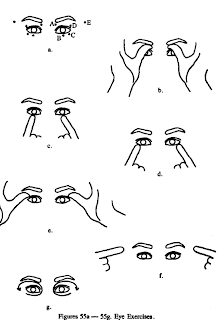
2. Next, place index fingers in the small depressions at the middle of the lower eye sockets-points designated by B. Press in deeply on the rims, not cheekbones. Massage for a count of 10. Release. Then repeat for a total of 3 times.
3. Then, place index fingers on lower eye socket 1/4 of the distance from outside comers of the eyes. (Look for letter C in figure 55d.) Press and massage for a count of 10. Release. Repeat for a total of 3 times.
4. Place middle fingers on top of eye sockets about 1/3of the distance from the outside comers of the eyes. (Look for letter D.) Press and massage for a count of 10. Release. Repeat for a total of 3 times.
5. Place middle fingers on the temples by coming out from the end of the eyebrows and locating soft depressions on the sides of the head (point E). Press and massage for a count of 10. Release. Repeat for a total of 3 times.
6. Palming. Rub hands together briskly until they are quite wann. Cup the hands over both eyes, fingers slightly crossed, right over left. Do not press the eyes. Hold for a count of 10. Then repeat for a total of 3 times, always feeling the wannth entering into the eyes from the hands.
7. Then rub eyes lightly with three middle fingers. Rub the bones around the eyes in a circular motion, starting from the inside comer of each eye next to the nose. Rub up the bridge of the nose, across the eyebrows, towards the temples, down and back around the lower rims ofthe eye sockets to the nose again. Do this 10 times. Pause. Repeat for a total of 3 cycles.
NOTE A: Rubbing in the opposite direction will weaken the eye muscles and cause wrinkles to appear. Always use a natural, heal ing cream as a lubricant.
NOTE B: For cataract or glaucoma, practice the first seven eye
exercises up to 20 minutes daily. Whenever your eyes are tired, do the Eye Exercises, as they will completely revitalize your entire body in minutes. It is also good to do them in conjunction with exercises which strengthen the liver.
NOTE C:Once you have located the painful points, it is not necessary to continue pressing hard on these points. When you are doing the Eye Exereises,even a very light touching of the points will accomplish the purpose of the exercise, which is to restore nonnal vision. NOTED: Use the first two points (A and B) for diagnosis. If it is painful at all when you press in deeply, then there is something wrong with the eyes and/or body. If it is puffy or dark under point B, water retention or lack of proper rest is indicated.
One may also practice additional exercises which will strengthen the eyes and the muscles surrounding them.
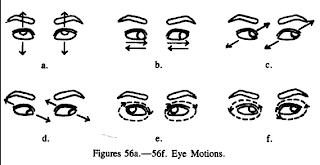 1. Begin by keeping the head straight, but with the eyes first looking up toward the ceiling and then down at the floor. Repeat this motion several times. The eyes should always move slowly and with deliber ation.
2. Next, look to either side of the head.
3. Then look up and down into the opposite comers of the eyes.
4. Then rotate the eyes frrst in a clockwise direction, then in a counterelockwise direction. This will take about ten minutes to per fonn when done slowly.
5. Always follow these eye movements with a rubbing of the hands and a pressing of the palms onto the eyes to bring heat and energy into them.
The eyes, specifically their movements, are indicative of an individual's intelligence. People who are clever have large eye movements and are always exploring their environment. Slow eye movement or a lack of eye movement indicates a repressed level of intelligence, which may also be helped through stimulation of the eyes.
Poor blood circulation, indicated by dark circles under the eyes, can also be helped by doing the Eye Exercises. Poor blood circulation results from long periods of inactivity, such as those spent in front of a television set.
Often the first signs of sluggish circulation are chilly sensations, which result when the body temperature rises above room temperature, causing the surroundings to be cooler than the body. Like car engines, our bodies need cool liquids to circulate through them and remove heat. H circulation is sluggish, body temperature goes up. Then the blood ..boils", forms skins, and forms clots. So in order to prevent blood clots, the Eye and other Internal Exercises should be done, especially when television is being watched.
Doing the Eye Exercise can also help bags or puffiness under the eyes which indicate water retention or bad metabolism.
I. Place thumbs on rim of the eye sockets at the upper inside corner of the eyes. There is a slight depression in the bone at the correct point. Those points are designated by the letter A in figure 55a. Press in deeply. Any pain indicates some blockage. Then massage the points for a count of 10. Release. Repeat for a total of 3 times

2. Next, place index fingers in the small depressions at the middle of the lower eye sockets-points designated by B. Press in deeply on the rims, not cheekbones. Massage for a count of 10. Release. Then repeat for a total of 3 times.
3. Then, place index fingers on lower eye socket 1/4 of the distance from outside comers of the eyes. (Look for letter C in figure 55d.) Press and massage for a count of 10. Release. Repeat for a total of 3 times.
4. Place middle fingers on top of eye sockets about 1/3of the distance from the outside comers of the eyes. (Look for letter D.) Press and massage for a count of 10. Release. Repeat for a total of 3 times.
5. Place middle fingers on the temples by coming out from the end of the eyebrows and locating soft depressions on the sides of the head (point E). Press and massage for a count of 10. Release. Repeat for a total of 3 times.
6. Palming. Rub hands together briskly until they are quite wann. Cup the hands over both eyes, fingers slightly crossed, right over left. Do not press the eyes. Hold for a count of 10. Then repeat for a total of 3 times, always feeling the wannth entering into the eyes from the hands.
7. Then rub eyes lightly with three middle fingers. Rub the bones around the eyes in a circular motion, starting from the inside comer of each eye next to the nose. Rub up the bridge of the nose, across the eyebrows, towards the temples, down and back around the lower rims ofthe eye sockets to the nose again. Do this 10 times. Pause. Repeat for a total of 3 cycles.
NOTE A: Rubbing in the opposite direction will weaken the eye muscles and cause wrinkles to appear. Always use a natural, heal ing cream as a lubricant.
NOTE B: For cataract or glaucoma, practice the first seven eye
exercises up to 20 minutes daily. Whenever your eyes are tired, do the Eye Exercises, as they will completely revitalize your entire body in minutes. It is also good to do them in conjunction with exercises which strengthen the liver.
NOTE C:Once you have located the painful points, it is not necessary to continue pressing hard on these points. When you are doing the Eye Exereises,even a very light touching of the points will accomplish the purpose of the exercise, which is to restore nonnal vision. NOTED: Use the first two points (A and B) for diagnosis. If it is painful at all when you press in deeply, then there is something wrong with the eyes and/or body. If it is puffy or dark under point B, water retention or lack of proper rest is indicated.
One may also practice additional exercises which will strengthen the eyes and the muscles surrounding them.
 1. Begin by keeping the head straight, but with the eyes first looking up toward the ceiling and then down at the floor. Repeat this motion several times. The eyes should always move slowly and with deliber ation.
2. Next, look to either side of the head.
3. Then look up and down into the opposite comers of the eyes.
4. Then rotate the eyes frrst in a clockwise direction, then in a counterelockwise direction. This will take about ten minutes to per fonn when done slowly.
5. Always follow these eye movements with a rubbing of the hands and a pressing of the palms onto the eyes to bring heat and energy into them.
Interesting Facts
A South Indian Meal
A typical South Indian meal is served in three main courses: sambar sAdam, rasam sAdam and more (buttermilk) sAdam.
Sambar is also known as kuzhambu in Tamil, a term that literally translates to 'get confused'. Paramacharya explains how these three courses are related to the three gunas of spirituality: the confusion of sambar is tamo guna, the clarified and rarified flow of rasam is rajo guna and the all-white buttermilk is satva guna. Our meal reminds us of our spiritual path from confused inaction to a clear flow of action and finally to the realized bliss of unity.
Also thought i would add what i have heard
(I heard that Paramacharya once asked the difference between Sambar and Rasam.The ingredients are same for both like tamarind water,dal etc.Then what exactly is the difference? Then he replied the only difference is 'Than'(vegetable in tamil).This also means 'I' (in spritual context).When every one is born on this earth ,all of them are born with the thought of 'I'.
The moment we start filtering and removing the thought of 'I' slowly we progress and clarity sets in (which is Rasam clear and light when compared to sambar).Then we enjoy the boga,Bogyam (happiness )in life which is Payasam (after rasam payasam is served) .How much of payasam can we eat??After enjoying happiness in life till we are bored of it,then we move to More (buttermilk) which is the goal every one has to attain.More (buttermilk) cant be refined any further.From Milk we get Curd ,curd when refined becomes More (buttermilk),beyond that how much every we refine ,what remains is Buttermilk(more).The entire south indian meal as described by Mahaperiyava is to remaind people that path and the steps ahead to reach the Paramathma.After More (buttermilk) we wash our hands (NO MORE) ..(wht a sattire) by thatha...
sAdam
Cooked rice, the main dish of a South Indian meal is called sAdam. That which has sat is sAdam, in the same way we call those who are full of sat, sadhus. We can give another explanation for the term: that which is born out of prasannam is prasAdam. What we offer to Swami (God) as nivedanam is given back to us as parasAdam. Since we should not add the root 'pra' to the rice we cook for ourselves, we call it sAdam.
Rasam
Rasam means juice, which is also the name of filtered ruchi. We say 'it was full of rasa' when a speech or song was tasteful. Vaishnavas, because of their Tamil abhimAnam, refer to rasam as saatthamudhu. It does not mean the amudhu (amrita) mixed with sAdam. It was actually saatramudhu (saaru or rasam + amudhu), which became saatthamudhu.
Vaishnavas also have a term thirukkann amudhu that refers to our pAyasam. What is that thirukkann? If rudrAksham means Rudra's eye, does 'thirukkann' mean Lakshmi's eye? Or does the term refer to some vastu (article) added to pAyasam? No such things. Thiru kannal amudhu has become thirukkann amudhu. Kannal means sugercane, the base crop of suger and jaggery used in pAyasam.
I was talking about rasam. If something is an extraction of juice, then would it not be clear, diluted and free of sediments? Such is the nature of our rasam, which is clear and dilute. The other one, served earlier to rasam in a meal, is the kuzhambu. Kuzhambu contains dissolved tamarind and cut vegetable pieces, so it looks unclear, its ingredients not easily seen.
Buttermilk
A western meal normally ends with a dessert. In a South Indian meal, desserts such as pAyasam are served after the rasam sAdam. Any sweets that were served at the beginning are also taken at this time. After that we take buttermilk rice as our final course. Paramacharya explains that since sweets are harmful to teeth, our sour and salty buttermilk actually strengthens our teeth, and this has been observed and praised by an American dietician. We gargle warm salt water when we get toothache. The buttermilk is the reason for our having strong teeth until the end of our life, unlike the westerners who resort to dentures quite early in their life.
Vegetable curry
Even though cut vegetable pieces are used in sambar, kootoo and pacchadi, in curry they are fried to such an extent that they become dark in color (the term curry also means blackness or darkness in Tamil). May be this is the origin of the name curry.
Uppuma (kitchadi)
I f the term uppuma is derived from the fact that we add uppu or salt, then we also add salt to iddly, dosa and pongal! Actually, it is not uppuma but ubbuma! The rava used for this dish expands in size to the full vessel where heated up with water and salt. The action of rava getting expanded is the reason for the term ubbuma.
Iddly
The term iduthal (in Tamil) refers to keeping something set and untouched. We call the cremation ground idukaadu (in Tamil). There we keep the mrita sarira (mortal body) set on the burning pyre and then come away. The term iduthal also refers to refining gold with fire. The (Tamil) term idu marunthu has a similar connotation: a drug given once without any repetition of dosage. In the same way, we keep the iddly wet flour on the oven and do nothing to it until it is cooked by steam.
Idiyaappam
(This is rice noodles cooked in steam). Brahmins call it seva while others call it idiyaappam. But unlike an appam which is a cake, this dish is in strands. The term appam is derived from the Sanskrit ApUpam meaning cake. The flour of that cake is called ApUpayam. This word is the origin of the Tamil word appam.
Appalaam
The grammatical Tamil term is appalam. This dish is also made by kneading (urad dhal) flour, making globules out of it and then flattening them. So it is also a kind of appam. Because of its taste a 'la' is added as a particle of endearment!
Laddu
ladanam (in Sanskrit) means to play, to throw. ladakam is the sports goods used to play with. Since the ball games are the most popular, ladakam came to mean a ball. The dish laddu is like a ball, and this term is a shortened form of laddukam, which derived from ladakam.
Laddu is also known as kunjaa laadu. This should actually be gunjaa laadu, because the Sanskrit term gunjA refers to the gunjA-berry, used as a measure of weight, specially for gold. Since a laddu is a packed ball of gunjA like berries cooked out of flour and sugar, it got this name.
The singer of mUka panca sati on Ambal Kamakshi describes her as Matangi and in that description praises her as 'gunjA bhUsha', that is, wearing chains and bangles made of gunjA-berries of gold.
Pori vilangaa laddu
Made of jaggery, rice flour and dried ginger without any ghee added to it, this laddu is as hard as a wood apple, though very tasty, and hence got its name from that fruit and the original pori (puffed rice) flour used to make it.
Indian Dishes of Turkish Origin
Our halwa is a dish that came from the Turkish invasion. bahU kalam (long ago) before that we had a dish called paishtikam, made of flour, ghee and sugar. But then the Arabian term halwa has stuck in usage for such preparation.
Sojji
sUji is another name from the Turkish. It has become sojji now. It is mostly referred to these days as kesari. In Sanskrit, kesaram means mane, so kesari is a lion with kesaram. It was a practice to add the title 'kesari' to people who are on the top in any field. Thus we have Veera Kesari, Hari Kesari as titles of kings in Tamilnadu. The German Keisar, Roman Caesar and the Russian Czar -- all these titles came from only from this term kesari.
What is the color the lion? A sort of brownish red, right? A shade that is not orange nor red. That is the kesar varnam. The powder of that stone is called kesari powder, which became the name of the dish to which it is added for color.
Vada
A Tamil pundit told me that the name vada(i) could have originated from the Sanskrit mAshApUpam, which is an appam made of mAsham or the urad dhal. He also said that in ancient Tamilnadu, vada and appam were prepared like chapati, baking the flour cake using dry heat.
Dadhya Araadhana
Someone asked me about the meaning of this term. He was under the impression that dadhi was curd, so dadhiyaaradhana(i) was the curd rice offered to Perumal. Actually, the correct term is tadeeya AradhanA, meaning the samaaradhana(i) (grand dinner) hosted to the bhagavatas of Perumal. It got shortened in the habitual Vaishnava way.
Vaishnavas offer the nivedanam of pongal with other things to Perumal in their dhanur mAsa ushad kala puja (early morning puja of the Dhanur month). They call it tiruppakshi. The original term was actually tiruppalli ezhuchi, the term used to wake of Perumal. It became 'tiruppazhuchi', then 'tiruppazhachi' and finally 'tiruppakshi' today, using the Sanskrit kshakara akshram, in the habitual Vaishnava way. It is only vegetarian offering, nothing to do with pakshi (bird)!
The term dhanur mAsam automatically brings up thoughts of Andaal and her paavai (friends). In the 27th song (of Tiruppaavai), she describes her wake up puja and nivedanam with milk and sweet pongal to Bhagavan, which culminates in her having a joint dinner with her friends. Vaishnavas celebrate that day as the festival koodaara valli, following the same sampradhAyam (tradition). The name of this festival is from the phrase koodaarai vellum seer Govinda, (Govinda who conquers those who don't reach Him) which begins the 27th song. It was this 'koodaarai vellum' that took on the vichitra vEsham (strange form) of 'koodaara valli'.
pAyasam
payas (in Sanskrit) means milk. So pAyasam literally means 'a delicacy made of milk'. This term does not refer to the rice and jaggery used to make pAyasam. They go with the term without saying. Actually pAyasam is to be made by boiling rice in milk (not water) and adding jaggery. These days we have dhal pAyasam, ravA pAyasam, sEmia pAyasam and so on, using other things in the place of rice.
Vaishanavas have a beautiful Tamil term akkaara adisil for pAyasam. The 'akkaar' in this term is a corruption of the Sanskrit sharkara. The English term 'sugar' is from the Arabian 'sukkar', which in turn is from this Sanskrit term. The same term also took the forms 'saccharine' and 'jaggery'. And the name of the dish jangiri is from the term jaggery.
kanji
Before we become satiated with madhuram (sweetness), let us turn our attention to a food that is sour. As an alternative to sweetness, our Acharyal (Adi Sankara) has spoken about sourness in his Soundarya Lahiri.
Poets describe a bird called cakora pakshi that feeds on moon-beams. Sankara says in Soundarya Lahiri that the cakora pakshi were originally feeding on the kArunya lAvaNyAmruta (the nectar of compassion and beauty) flowing from Ambal's mukha chanran (moon like face). They got satiated with that nectar and were looking for somthing sour, and spotted the full moon, which being only a reflection, issued only sour beams!
Acharyal has used the term kAnjika diya, which gives an evidence of his origin in the Malayala Desam. He said that since the cakora pakshis were convinced that the nectar from the moon was only sour kanji, they chose to feed on it as an alternative.
The term kAnjika means relating to kanji, but the word kanji is not found in Sanskrit. It is a word current only in the Dakshinam (south). There too, kanji is special in Malayala Desam where even the rich lords used to drink kanji in the morning. This was the variety came to be known as the 'Mayalayam Kanji'.
Kanji is good for deham as well as chittam. And less expensive. You just add a handful of cooked rice rava (broken rice), add buttermilk, salt and dry ginger, which would be enough for four people.
The buttermilk added must be a bit more sour. The salt too must be a bit more in quantity. With the slight burning taste of dry ginger, the combination would be tasty and healthy.
tAmbUlam
It is customary to have tAmbUlam at the end of a South Indian dinner. In the North, tAambUlam is popularly known as paan, which is usually a wrap of betel nut and other allied items in a calcium-laced pair of betel leaves. In the South, tAmbUlam is usually an elaborate and leisurely after-dinner activity. People sit around a plate of tAmbUlam items, drop a few cut or sliced betel nut pieces in their month, take the betel leaves one by one leisurely, draw a daub of pasty calcium on their back and then stuff them in their month, chatting happily all the while.
The betel leaf is known by the name vetrilai in Tamil, literally an empty leaf. Paramacharya once asked the people sitting around him the reason for calling it an empty leaf. When none could give the answer, he said that the usually edible plants don't just stop with leaf; they proceed to blossom, and bear fruits or vegetables. Even in the case of spinach or lettuce, we have to cook them before we can take them. Only in the case of the betel leaf, we take it raw, and this plant just stops with its leaves, hence the name vetrilai or empty leaf.
-------
विद्या ददाति विनयम्, विनयम् ददाति पात्रताम्, पात्रत्वात् धनमाप्नोति, धनात् धर्मम् ततःसुखम्Education yields humility; humility yields character; character yields wealth (courage, fortitude & wisdom); wealth supports righteous (dharmic) life; righteousness yields happiness. - Hitopadesha
A typical South Indian meal is served in three main courses: sambar sAdam, rasam sAdam and more (buttermilk) sAdam.
Sambar is also known as kuzhambu in Tamil, a term that literally translates to 'get confused'. Paramacharya explains how these three courses are related to the three gunas of spirituality: the confusion of sambar is tamo guna, the clarified and rarified flow of rasam is rajo guna and the all-white buttermilk is satva guna. Our meal reminds us of our spiritual path from confused inaction to a clear flow of action and finally to the realized bliss of unity.
Also thought i would add what i have heard
(I heard that Paramacharya once asked the difference between Sambar and Rasam.The ingredients are same for both like tamarind water,dal etc.Then what exactly is the difference? Then he replied the only difference is 'Than'(vegetable in tamil).This also means 'I' (in spritual context).When every one is born on this earth ,all of them are born with the thought of 'I'.
The moment we start filtering and removing the thought of 'I' slowly we progress and clarity sets in (which is Rasam clear and light when compared to sambar).Then we enjoy the boga,Bogyam (happiness )in life which is Payasam (after rasam payasam is served) .How much of payasam can we eat??After enjoying happiness in life till we are bored of it,then we move to More (buttermilk) which is the goal every one has to attain.More (buttermilk) cant be refined any further.From Milk we get Curd ,curd when refined becomes More (buttermilk),beyond that how much every we refine ,what remains is Buttermilk(more).The entire south indian meal as described by Mahaperiyava is to remaind people that path and the steps ahead to reach the Paramathma.After More (buttermilk) we wash our hands (NO MORE) ..(wht a sattire) by thatha...
sAdam
Cooked rice, the main dish of a South Indian meal is called sAdam. That which has sat is sAdam, in the same way we call those who are full of sat, sadhus. We can give another explanation for the term: that which is born out of prasannam is prasAdam. What we offer to Swami (God) as nivedanam is given back to us as parasAdam. Since we should not add the root 'pra' to the rice we cook for ourselves, we call it sAdam.
Rasam
Rasam means juice, which is also the name of filtered ruchi. We say 'it was full of rasa' when a speech or song was tasteful. Vaishnavas, because of their Tamil abhimAnam, refer to rasam as saatthamudhu. It does not mean the amudhu (amrita) mixed with sAdam. It was actually saatramudhu (saaru or rasam + amudhu), which became saatthamudhu.
Vaishnavas also have a term thirukkann amudhu that refers to our pAyasam. What is that thirukkann? If rudrAksham means Rudra's eye, does 'thirukkann' mean Lakshmi's eye? Or does the term refer to some vastu (article) added to pAyasam? No such things. Thiru kannal amudhu has become thirukkann amudhu. Kannal means sugercane, the base crop of suger and jaggery used in pAyasam.
I was talking about rasam. If something is an extraction of juice, then would it not be clear, diluted and free of sediments? Such is the nature of our rasam, which is clear and dilute. The other one, served earlier to rasam in a meal, is the kuzhambu. Kuzhambu contains dissolved tamarind and cut vegetable pieces, so it looks unclear, its ingredients not easily seen.
Buttermilk
A western meal normally ends with a dessert. In a South Indian meal, desserts such as pAyasam are served after the rasam sAdam. Any sweets that were served at the beginning are also taken at this time. After that we take buttermilk rice as our final course. Paramacharya explains that since sweets are harmful to teeth, our sour and salty buttermilk actually strengthens our teeth, and this has been observed and praised by an American dietician. We gargle warm salt water when we get toothache. The buttermilk is the reason for our having strong teeth until the end of our life, unlike the westerners who resort to dentures quite early in their life.
Vegetable curry
Even though cut vegetable pieces are used in sambar, kootoo and pacchadi, in curry they are fried to such an extent that they become dark in color (the term curry also means blackness or darkness in Tamil). May be this is the origin of the name curry.
Uppuma (kitchadi)
I f the term uppuma is derived from the fact that we add uppu or salt, then we also add salt to iddly, dosa and pongal! Actually, it is not uppuma but ubbuma! The rava used for this dish expands in size to the full vessel where heated up with water and salt. The action of rava getting expanded is the reason for the term ubbuma.
Iddly
The term iduthal (in Tamil) refers to keeping something set and untouched. We call the cremation ground idukaadu (in Tamil). There we keep the mrita sarira (mortal body) set on the burning pyre and then come away. The term iduthal also refers to refining gold with fire. The (Tamil) term idu marunthu has a similar connotation: a drug given once without any repetition of dosage. In the same way, we keep the iddly wet flour on the oven and do nothing to it until it is cooked by steam.
Idiyaappam
(This is rice noodles cooked in steam). Brahmins call it seva while others call it idiyaappam. But unlike an appam which is a cake, this dish is in strands. The term appam is derived from the Sanskrit ApUpam meaning cake. The flour of that cake is called ApUpayam. This word is the origin of the Tamil word appam.
Appalaam
The grammatical Tamil term is appalam. This dish is also made by kneading (urad dhal) flour, making globules out of it and then flattening them. So it is also a kind of appam. Because of its taste a 'la' is added as a particle of endearment!
Laddu
ladanam (in Sanskrit) means to play, to throw. ladakam is the sports goods used to play with. Since the ball games are the most popular, ladakam came to mean a ball. The dish laddu is like a ball, and this term is a shortened form of laddukam, which derived from ladakam.
Laddu is also known as kunjaa laadu. This should actually be gunjaa laadu, because the Sanskrit term gunjA refers to the gunjA-berry, used as a measure of weight, specially for gold. Since a laddu is a packed ball of gunjA like berries cooked out of flour and sugar, it got this name.
The singer of mUka panca sati on Ambal Kamakshi describes her as Matangi and in that description praises her as 'gunjA bhUsha', that is, wearing chains and bangles made of gunjA-berries of gold.
Pori vilangaa laddu
Made of jaggery, rice flour and dried ginger without any ghee added to it, this laddu is as hard as a wood apple, though very tasty, and hence got its name from that fruit and the original pori (puffed rice) flour used to make it.
Indian Dishes of Turkish Origin
Our halwa is a dish that came from the Turkish invasion. bahU kalam (long ago) before that we had a dish called paishtikam, made of flour, ghee and sugar. But then the Arabian term halwa has stuck in usage for such preparation.
Sojji
sUji is another name from the Turkish. It has become sojji now. It is mostly referred to these days as kesari. In Sanskrit, kesaram means mane, so kesari is a lion with kesaram. It was a practice to add the title 'kesari' to people who are on the top in any field. Thus we have Veera Kesari, Hari Kesari as titles of kings in Tamilnadu. The German Keisar, Roman Caesar and the Russian Czar -- all these titles came from only from this term kesari.
What is the color the lion? A sort of brownish red, right? A shade that is not orange nor red. That is the kesar varnam. The powder of that stone is called kesari powder, which became the name of the dish to which it is added for color.
Vada
A Tamil pundit told me that the name vada(i) could have originated from the Sanskrit mAshApUpam, which is an appam made of mAsham or the urad dhal. He also said that in ancient Tamilnadu, vada and appam were prepared like chapati, baking the flour cake using dry heat.
Dadhya Araadhana
Someone asked me about the meaning of this term. He was under the impression that dadhi was curd, so dadhiyaaradhana(i) was the curd rice offered to Perumal. Actually, the correct term is tadeeya AradhanA, meaning the samaaradhana(i) (grand dinner) hosted to the bhagavatas of Perumal. It got shortened in the habitual Vaishnava way.
Vaishnavas offer the nivedanam of pongal with other things to Perumal in their dhanur mAsa ushad kala puja (early morning puja of the Dhanur month). They call it tiruppakshi. The original term was actually tiruppalli ezhuchi, the term used to wake of Perumal. It became 'tiruppazhuchi', then 'tiruppazhachi' and finally 'tiruppakshi' today, using the Sanskrit kshakara akshram, in the habitual Vaishnava way. It is only vegetarian offering, nothing to do with pakshi (bird)!
The term dhanur mAsam automatically brings up thoughts of Andaal and her paavai (friends). In the 27th song (of Tiruppaavai), she describes her wake up puja and nivedanam with milk and sweet pongal to Bhagavan, which culminates in her having a joint dinner with her friends. Vaishnavas celebrate that day as the festival koodaara valli, following the same sampradhAyam (tradition). The name of this festival is from the phrase koodaarai vellum seer Govinda, (Govinda who conquers those who don't reach Him) which begins the 27th song. It was this 'koodaarai vellum' that took on the vichitra vEsham (strange form) of 'koodaara valli'.
pAyasam
payas (in Sanskrit) means milk. So pAyasam literally means 'a delicacy made of milk'. This term does not refer to the rice and jaggery used to make pAyasam. They go with the term without saying. Actually pAyasam is to be made by boiling rice in milk (not water) and adding jaggery. These days we have dhal pAyasam, ravA pAyasam, sEmia pAyasam and so on, using other things in the place of rice.
Vaishanavas have a beautiful Tamil term akkaara adisil for pAyasam. The 'akkaar' in this term is a corruption of the Sanskrit sharkara. The English term 'sugar' is from the Arabian 'sukkar', which in turn is from this Sanskrit term. The same term also took the forms 'saccharine' and 'jaggery'. And the name of the dish jangiri is from the term jaggery.
kanji
Before we become satiated with madhuram (sweetness), let us turn our attention to a food that is sour. As an alternative to sweetness, our Acharyal (Adi Sankara) has spoken about sourness in his Soundarya Lahiri.
Poets describe a bird called cakora pakshi that feeds on moon-beams. Sankara says in Soundarya Lahiri that the cakora pakshi were originally feeding on the kArunya lAvaNyAmruta (the nectar of compassion and beauty) flowing from Ambal's mukha chanran (moon like face). They got satiated with that nectar and were looking for somthing sour, and spotted the full moon, which being only a reflection, issued only sour beams!
Acharyal has used the term kAnjika diya, which gives an evidence of his origin in the Malayala Desam. He said that since the cakora pakshis were convinced that the nectar from the moon was only sour kanji, they chose to feed on it as an alternative.
The term kAnjika means relating to kanji, but the word kanji is not found in Sanskrit. It is a word current only in the Dakshinam (south). There too, kanji is special in Malayala Desam where even the rich lords used to drink kanji in the morning. This was the variety came to be known as the 'Mayalayam Kanji'.
Kanji is good for deham as well as chittam. And less expensive. You just add a handful of cooked rice rava (broken rice), add buttermilk, salt and dry ginger, which would be enough for four people.
The buttermilk added must be a bit more sour. The salt too must be a bit more in quantity. With the slight burning taste of dry ginger, the combination would be tasty and healthy.
tAmbUlam
It is customary to have tAmbUlam at the end of a South Indian dinner. In the North, tAambUlam is popularly known as paan, which is usually a wrap of betel nut and other allied items in a calcium-laced pair of betel leaves. In the South, tAmbUlam is usually an elaborate and leisurely after-dinner activity. People sit around a plate of tAmbUlam items, drop a few cut or sliced betel nut pieces in their month, take the betel leaves one by one leisurely, draw a daub of pasty calcium on their back and then stuff them in their month, chatting happily all the while.
The betel leaf is known by the name vetrilai in Tamil, literally an empty leaf. Paramacharya once asked the people sitting around him the reason for calling it an empty leaf. When none could give the answer, he said that the usually edible plants don't just stop with leaf; they proceed to blossom, and bear fruits or vegetables. Even in the case of spinach or lettuce, we have to cook them before we can take them. Only in the case of the betel leaf, we take it raw, and this plant just stops with its leaves, hence the name vetrilai or empty leaf.
-------
विद्या ददाति विनयम्, विनयम् ददाति पात्रताम्, पात्रत्वात् धनमाप्नोति, धनात् धर्मम् ततःसुखम्Education yields humility; humility yields character; character yields wealth (courage, fortitude & wisdom); wealth supports righteous (dharmic) life; righteousness yields happiness. - Hitopadesha
Subscribe to:
Posts (Atom)